
"coffee bean development"
30000 article(s) found

Does Catimorkatimo Coffee beans taste good? the Development and breeding process of Katim Coffee varieties
Professional Coffee knowledge Exchange more information on coffee beans Please follow the Coffee Workshop (official Wechat account cafe_style) Katim coffee beans were developed from a cross between rust-resistant Timor and Caturra in Portugal in 1959. Katim coffee beans are precocious and resistant to disease, and their yield is much higher than other varieties of commercial value. For this reason, we must be diligent in fertilizing

Costa Rican Coffee introduces the course of development and geographical location
Costa Rica's geographical location the coffee beans produced in the high latitudes of Costa Rica are famous in the world, full-bodied, mild in taste, but extremely sour. The coffee beans here have been carefully processed, which is why there is high-quality coffee. Tarasu, located in the south of SanJos, the capital of Costa Rica, is one of the most valued coffee growers in the country. Taara

Yushi UCC Coffee in Japan has set up a factory in Taiwan and introduced a self-developed roaster.
Professional coffee knowledge exchange more coffee bean information Please follow Coffee Workshop (Wechat official account cafe_style) Japanese coffee manufacturer UCC Youshi Coffee Co., Ltd. has invested NT $500 million to set up a factory in Yunlin Dou-6 Industrial Zone to introduce an independently developed roaster "AROMASTER", which will be completed today and put into operation in January next year, which is expected to bring about a trend in the coffee market. Well-known Japanese coffee manufacturer

A brief introduction to the Origin, Development, History and Culture of Niagara Lakadura Fine Coffee beans
With the exception of Ethiopia, the origin of Arabica, the mutants or mixed-race varieties cultivated or found in Central and South America, India and East Africa are mainly Tibica and bourbon, and the genetic complexity is far lower than that of Ethiopia. this is the main reason for the weak physique and poor disease resistance of Arabica outside Ethiopia. In addition, the most common thing between bourbon and Tibica is that there must be shade trees.

Development status of Dehong Coffee Industry _ cultivation of Dehong Coffee _ what is the quality of Dehong Coffee
Professional coffee knowledge exchange more coffee bean information Please pay attention to the coffee workshop (Wechat official account cafe_style) the unique natural conditions of Dehong Prefecture have created the outstanding quality of small grain coffee, its rich and mellow flavor, unique flavor, by Nestl é, Starbucks and other international famous coffee merchants as one of the best quality coffee in the world. The planting situation of ● Dehong is introduced in China

Democratic Republic of the Congo (DRC) to strengthen coffee industry to develop coffee information coffee network
High-quality coffee beans are refined by water treatment. The coffee beans with less impurities can be obtained by the water washing method, but if the water quality and time are not properly controlled during the fermentation process, the coffee beans will easily be infected with the sour taste of excessive fermentation. and dry beans also need to pay attention to timely re-inspection to prevent coffee beans from being contaminated by wet ground and sundries. Processed

Development status of Xinzhai Coffee in Lujiang, Baoshan. How about Yunnan small Coffee Brand-Lujiangba Coffee
Professional coffee knowledge exchange more coffee bean information please pay attention to the superior natural geographical and climatic conditions of the coffee workshop (Wechat official account cafe_style), making Yunnan small grain coffee favored by foreign businessmen for its excellent quality, and the export volume accounts for more than 50% of the country's coffee exports, ranking first in the country. But for a long time, 90% of the exports are low-priced raw coffee beans.

The sustainable development of boutique coffee what is the relationship between the best boutique coffee and sustainable development
With regard to the future of boutique coffee, we firmly believe that boutique coffee has the potential to thrive in a healthy environment and support the community in a sustainable manner. In order to cultivate a bright future of fine coffee, more and more coffee institutions are committed to pursuing sustainable economic, social and environmental dynamics to protect local and global communities and to establish a more flexible supply of sustainable coffee.

What kinds of espresso do Starbucks have
Professional coffee knowledge exchange more information about coffee beans Please follow the coffee workshop (Wechat official account cafe_style) Coffee types details: Acai: a rare Mundo Novo mutation found mainly in Brazil. Anacafe 14: a spontaneous Catimor-Pacamara hybrid further developed and released by Anacafe in 2014. This variety is considered to be rustproof, and

Coffee aroma can be guaranteed for 4 years UCC pushes "positive pressure pot" to be the first to list in Taiwan
▲UCC launched its own research and development of positive pressure pot coffee beans, claiming that coffee aroma can be guaranteed for 4 years. (Photo/Reporter Cai Huiru Photographed, the same as below) Reporter Cai Huiru/Taipei Report COFFEE LOVERs PLANET, the flagship store of UCC Group located in SOGO Dunhua Hall, opened one year ago and launched its own research and development of positive pressure cans for coffee bean sales. UCC spent 8 years developing coffee bean storage devices positive pressure cans, emphasizing the ability to

A brief introduction to the production process of geisha coffee beans-the planting situation and variety development of coffee beans
Haines, a Swede, in 1924. Elliott founded the Emerald Manor, which was not a coffee grower but a ranch. Forty years later, Daniel Lou in 1964. Mr. Bidarson's grandfather, Luther Ruffer. Mr. Bidarson bought the Emerald Manor in order to have an old home after retirement, grandfather Luthor. Mr. Bidasson was born in Sweden and served as president of the Bank of America and director of United Nations Development.

The Historical Development of Burundian Coffee Bean Industry the Progress of Coffee Farmers and the Story of Excellence Cup
The competition will increase fame for a short time and bring about a new wave and rapid development and progress in the industry. No, in addition to the spiritual impact, there are substantial economic changes. For example, the excellent Cup held in Burundi in 2012 not only changed the fate of award-winning farmers, but also enhanced the status of Burundian coffee in the world. Held for the first time since 1999

The Green Dream of Yunnan Coffee
In 2012, Yunnan is expected to produce 60, 000 tons of coffee, accounting for 98% of the country's coffee production and 7/1000 of the world's coffee production. Pu'er City, as an important producing area of small grain coffee in Yunnan, by the end of 2011, the planting area of coffee is 439000 mu, the output is 28000 tons, the output value is 850 million yuan, the planting area and output account for more than half of the country respectively. This year, new plants will be planted in Pu'er City.
Analysis on the Market pattern and Development trend of China's Coffee Industry in 2015
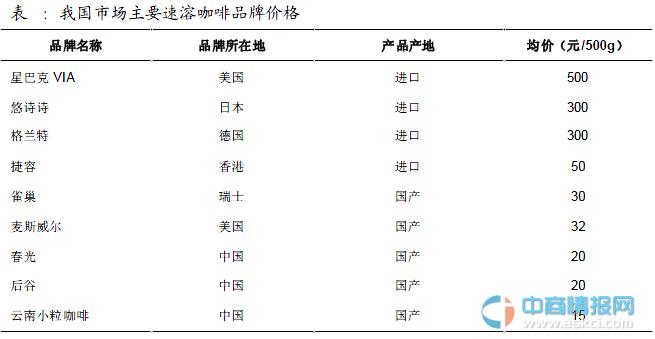
Judging from the current competition pattern of China's coffee industry, in the field of instant coffee, domestic products of foreign brands are in a monopoly position in the middle and low-end market segments, and coffee giants such as Nestle and Maxwell have a market share of more than 80%. In the future, China's local coffee enterprises, represented by Gu Coffee and Chunguang Food, are in a period of transition from raw bean cultivation and rough processing to self-branded coffee products.

The Origin and Development of El Salvador Mount Wula what is the variety of El Salvador Wula Mountain Coffee beans
Professional coffee knowledge exchange more coffee bean information please follow the coffee workshop (Wechat official account cafe_style)

Introduction to the treatment method of planting and developing History of single Bean Flavor description in Kenya
For the exchange of professional baristas, please follow the coffee workshop (Wechat official account cafe_style) Kenya Kenyan population: 44353000 Central Kenya produces the most coffee beans, of which the highest quality coffee beans also come from the central producing areas. At present, western Kenya is also interested in growing coffee, such as Kisi Kisii, Trans-Enzoya Trans-Nzoia, Keiba Keiyo, Malagua M.

What's the difference between artificial coffee and molecular coffee Finnish scientists have developed a new type of sustainable coffee
Finnish scientists have developed environmentally friendly "sustainable coffee" in the laboratory through a new technology, according to a number of media reports. On October 25th, Finnish scientist HeikoRischer was displayed in the laboratory of the Finnish Science and Technology Research Center (VTT) in Espoo.

How to get started with Coffee roasting | basic knowledge of Coffee Baking how to roast coffee beans at home
I bet baking is something every barista wants to know! We can develop the flavor by roasting coffee. How can we get the best taste of coffee? What actually happens when you bake? Why is baking important? Coffee beans are seeds that ripen in coffee cherries. They are then processed and dried into coffee beans. Before baking, the coffee beans are green
History of Coffee Development in China
According to historical records, planting in Taiwan was successful for the first time in 1884. Since then, coffee trees have been planted in China. Coffee planting in Daliu began in Yunnan Province. In 1902, a French missionary named Tian introduced seeds from India and Gong, and planted them successfully in Binchuan County, Yunnan Province, located in Zhukula, a tributary of Jinsha River. Commercial cultivation of Yunnan coffee began in 1985, but the development was slow.

A brief introduction to the history and culture of the origin, development and development of Alishan coffee in Taiwan.
I was surprised by the performance of this sun-dried bean. At first, it smelled dry and slightly fermented, but at the entrance, it suddenly turned into a clean, rich, multi-layered fruit with sweet and sour taste, without a hint of indecent taste. It was amazing. I was surprised that Taiwan could make such a great sun bean. Former chairman of the Fine Coffee Association of America and former Counter C.